
Table of Contents (Jump to section)



What Is Disc Golf? FAQ
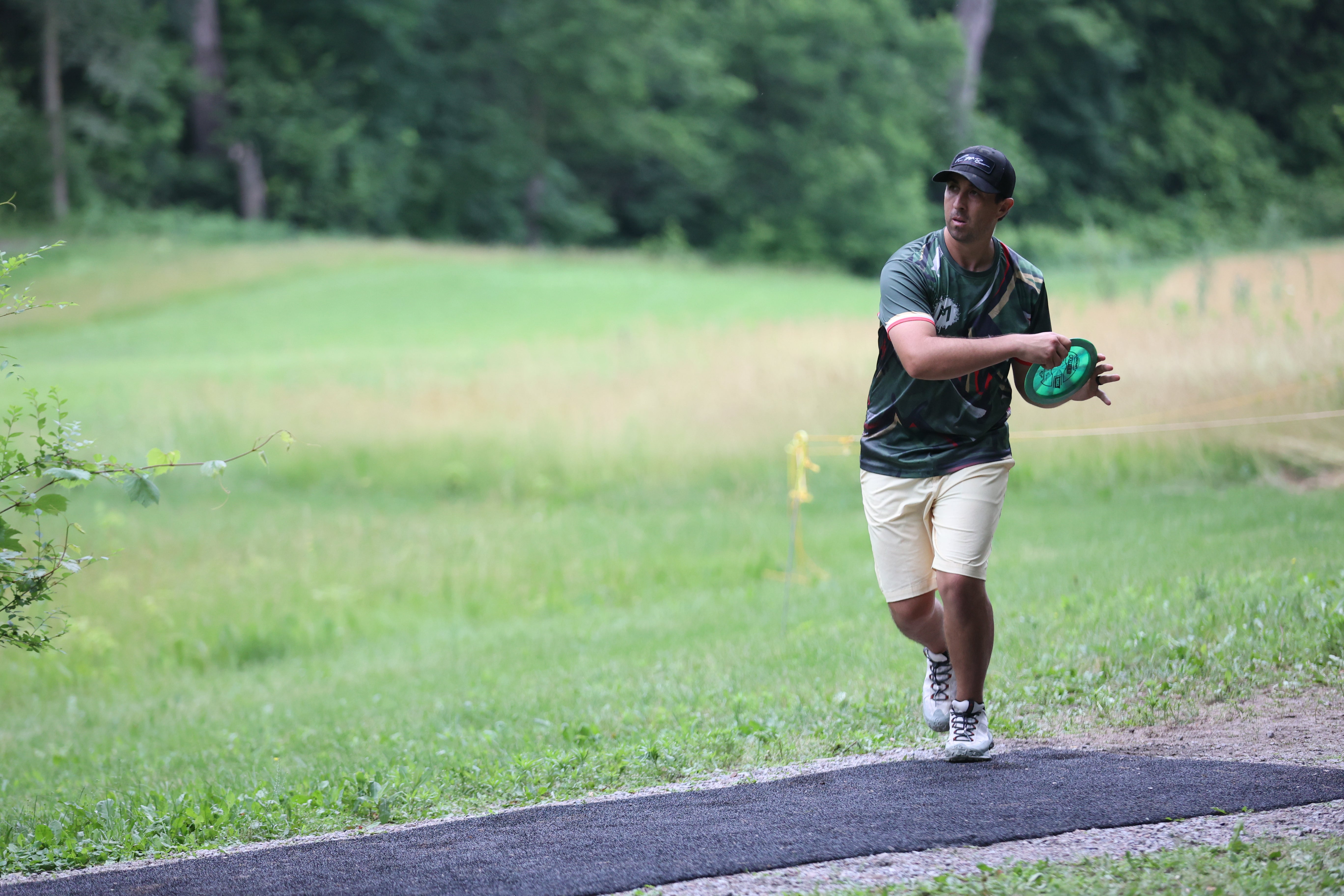
Disc golf is played similarly to traditional golf, but instead of clubs and a ball, players throw specialized flying discs toward a metal basket. Each hole begins at a tee area and ends when the disc comes to rest inside the basket. Every throw counts as a stroke, and the goal is to finish the course using the fewest throws possible.
Courses are typically located in public parks, wooded areas, or open fields and are often free to play. A round usually takes between one and two hours, depending on the course and group size.
What sets disc golf apart is its accessibility. Players of all ages, skill levels, and physical abilities can enjoy the game, and progress comes quickly with repetition and understanding
How a Disc Golf Hole Is Played
Each hole follows the same basic structure:
Tee Throw
The hole begins from a designated tee area. This is often a concrete or turf pad, but sometimes just a marked section of ground.
Lie & Subsequent Throws
Wherever the disc lands becomes the player's next lie. Each throw must be made from directly behind that spot.
Approach & Putt
As the player gets closer to the basket, throws become more about control and accuracy than distance.
Completion
The hole is finished when the disc comes to rest in the basket.
The player farthest from the basket always throws first, and players should never throw when others are in front of them.
Understanding Disc Golf Discs
Disc golf discs are engineered tools. Compared to a casual frisbee, they are smaller in diameter, heavier, and shaped to reduce air resistance while increasing lift and stability.
Disc Type Comparison
Putters (Speed 1–3)
Putters typically fly 100–200 feet and offer excellent control. They are best for putting, short approach shots, and for beginners learning proper throwing form.
Midrange Discs (Speed 4–6)
Midrange discs fly about 200–350 feet and provide very good control. They are versatile discs used for drives, controlled shots, and all-around play where accuracy is important.
Fairway Drivers (Speed 7–10)
Fairway drivers generally fly 300–450 feet. They balance distance and control, making them ideal for controlled tee shots, placement drives, and shaping lines through tight fairways.
Distance Drivers (Speed 11–15)
Distance drivers are built for maximum distance, often reaching 400+ feet. They require more power and technique, and are best suited for advanced players looking for long-distance drives.
Reading Disc Stability: How to Tell if a Disc is Understable or Overstable
Dome vs. Flat Top
High Dome (Bumpy): More lift, more stable, helps resist turn. Generally more overstable.
Flat Top: Less lift, easier to turn. Generally more understable.
Rim Shape
Sharp Edges: Usually more overstable, designed for distance drivers.
Rounded Edges: Usually more understable or stable, friendly for control.
Center of Gravity
Hold the disc and look at it from the side. A more forward-heavy disc (center of gravity closer to the front) is generally more overstable.
Best Teacher: Throw It
The flight numbers tell you the design intention, but the best way to understand a disc's actual stability is to throw it. Each disc has a personality based on plastic, wear, and how you throw it.
Putters, MIdranges, Fairway Drivers & Distance Drivers
Putters
Putters are the slowest and most controllable discs. They have deep rims, blunt edges, and are designed to fly straight at low speeds.
Key characteristics:
- Minimal side-to-side movement
- Slow, predictable flight
- Land softly with little skip
Putters are used primarily for putting, but they are also excellent teaching tools. Many experienced players still drive and approach with putters because they reveal form flaws immediately.
Midrange Discs
Midranges sit between putters and drivers in speed and distance. They have moderate rim widths and are designed to fly straight with minimal fade when thrown correctly.
Why midranges are ideal for beginners:
- Forgiving of imperfect releases
- Respond clearly to angle and power
- Useful for drives, approaches, and controlled shots
Fairway Drivers
Fairway drivers are faster than midranges but slower and more controllable than distance drivers. They have narrower rims and require moderate power.
They are commonly used for:
- Longer controlled drives
- Tight fairways
- Shots requiring accuracy over raw distance
Distance Drivers
Distance drivers have the widest rims and highest speed ratings. They are designed to generate maximum distance when thrown with significant arm speed and spin.
For beginners:
- They often fade early
- They exaggerate form mistakes
- They rarely fly as intended
Flight Numbers Explained in Detail
Flight numbers describe how a disc is designed to fly under ideal conditions. These numbers assume the disc is thrown at the correct speed, with clean spin and proper angles.
Speed
Speed measures how fast a disc must be thrown to perform as designed. It is strongly tied to rim width.
Important concepts:
- Speed does NOT equal distance
- A disc thrown too slowly will fade early
- Higher speed discs behave more overstable when underpowered
- Lower speed discs are more efficient for beginners
Glide
Glide measures a disc's ability to stay airborne.
High glide discs:
- Generate more lift
- Travel farther with less effort
- Are more affected by wind
Low glide discs:
- Drop faster
- Offer more control
- Are useful in windy conditions or short approaches
Turn (High-Speed Turn)
Turn describes how a disc behaves during the fastest part of its flight.
For a right-handed backhand throw:
- Negative turn numbers mean the disc turns right
- Positive turn numbers mean resistance to turning
Understable discs (negative turn):
- Require less power
- Help newer players achieve straight or right-moving flights
- Excel in tailwinds and uphill shots
Fade (Low-Speed Fade)
Fade describes how a disc behaves as it slows down near the end of its flight.
Higher fade:
- Strong, predictable hook
- Useful for consistency and wind
Lower fade:
- Straighter finish
- Less dramatic ground play
Fade happens on every disc; the amount is what changes.
Wind Effects on Disc Flight
Headwind (Wind in Your Face)
A strong headwind effectively makes the disc behave more understable because it increases the relative airspeed over the disc.
That means:
- More high-speed turn
- Later / reduced fade
- Greater chance of flipping or rolling
So players typically compensate by choosing:
- More overstable discs — resist turning in the wind
- Often faster discs — cut through wind better and maintain stability at higher airspeeds
Tailwind (Wind at Your Back)
A tailwind lowers the disc's effective airspeed, which makes discs act more overstable with less turn, earlier fade, and less glide.
So what do players usually throw?
Many players adjust by using:
- More understable discs — to get back the lost turn
- Sometimes slower discs — because you don't need as much speed to keep control and distance
- Glidier discs — to help fight the drop-out effect
Crosswind (Wind from the Side)
Crosswind pushes the disc sideways during flight, requiring adjustment.
- Throw into the wind slightly to compensate
- Stronger/more overstable discs resist drift better
- Lighter discs are more affected by lateral wind
What's Actually True About Wind & Stability
Lower-glide discs tend to be more predictable and less affected by wind, but glide itself does not equal stability.
- Glide measures how well a disc stays aloft
- Stability is controlled mainly by turn, fade, nose angle, speed, and shape
So a disc can be:
- High glide and very overstable
- Low glide and very understable
Why people say "low glide is more stable in wind":
In windy conditions, high-glide discs stay in the air longer → more time for wind to push them. Low-glide discs get to the ground sooner → less lateral movement. That feels like "more stable," but it's really less wind exposure, not true stability.
Very Windy Conditions: Why Mid-Range Over Distance Drivers
In very windy conditions:
- Distance drivers have wide rims → more wind interaction
- They rely on high speed to fly correctly
- Wind exaggerates turn, lift, and nose angle mistakes
Mid-ranges:
- Have narrower rims
- Are easier to keep nose-down
- Fly at lower speeds with more predictability
- Get pushed around less overall
So even though they're "slower," they often go farther and straighter in heavy wind.
The key factor:
It's really about stability, not just disc type. Overstable mid-range > understable distance driver in heavy wind. Overstable fairway can still work, but wide-rim distance drivers are usually the worst choice.
Stability: How Discs Really Fly
Stability is the combined result of speed, turn, and fade.
Flight Characteristics by Stability
- Extremely Understable - Immediate sharp turn, minimal fade
- Understable - Turns early, finishes gently
- Stable/Neutral - Holds release angle
- Overstable - Fades hard and early
- Extremely Overstable ("Meathook") - Sharp, immediate fade
Stability changes with:
- Plastic type
- Wear and tear
- Throwing speed
- Release angle
- Spin rate
Plastic Types and Wear
Plastic type dramatically affects grip, durability, and flight behavior.
Base Plastics
- Better grip in all conditions
- Less durable
- Break in quickly
- Become more understable with use
- Great for beginners due to feel and affordability
Premium Plastics
- More durable
- Retain flight characteristics longer
- Often more overstable when new
- Resist wear and deformation
Disc Weight and Performance
Weight influences distance, control, and wind resistance.
Lighter discs:
- Easier to accelerate
- Travel farther for slower arm speeds
- More affected by wind
Heavier discs:
- Offer stability in wind
- Require more power
- Provide consistency for advanced players
Recommended beginner range:
- Youth: 120–150g
- Adult beginners: 150–160g
Common Mistakes Beginners Make
Throwing Too Hard Too Soon
Trying to throw with maximum effort before developing proper form leads to wild throws, injuries, and bad habits that stick around. Start slow and focus on smooth, controlled acceleration.
Buying Too Many Discs At Once
A 14-disc bag confuses beginners. You can't learn what each disc does if you never throw it. Start with one putter, one midrange, and one fairway driver. Add more as you understand the game.
Improper Grip Causing Arm Stress
A weak grip or wrong grip pressure leads to tendonitis, elbow pain, and shoulder issues. Learn proper grip early and listen to your body. Pain is a signal to stop and reassess, not push through.
Not Maintaining Consistent Form
Changing your throw every time you play prevents learning. Repetition with the same motion teaches your body the mechanics. Practice the same throw 50 times before changing technique.
Neglecting Short Game Practice
New players obsess over distance when putting and approach shots determine scores. Spend 50% of practice time within 200 feet. Short game wins rounds.
Wrong Weight Selection
Discs that are too heavy lead to poor form and fatigue. Too light and you lose control. Start at 150-160g for adults and adjust based on feel, not distance.
Choosing Your First Disc
The ideal beginner disc:
- Midrange
- Neutral stability
- Lightweight
- Minimal fade
One disc is often better than many. It allows players to learn:
- Release angles
- Nose angle control
- Spin vs speed
- Shot shaping
Starter sets are a convenient alternative, offering a balanced introduction without overwhelming choices.
Throwing Fundamentals
Release Angles (Nose Angle)
Backhand Throw
The most common and fundamental throw. Proper backhand form relies on:
- Smooth acceleration
- Weight transfer
- Clean release
- Nose-down angle
Throwing nose-up causes discs to stall and fade early.
Forehand (Flick)
A sidearm throw using wrist snap and finger pressure. Useful but harder to control early and often more stressful on the arm.
Grips Explained
- Fan Grip: Control and accuracy, ideal for short shots
- Power Grip: Maximum distance and spin
Grip choice affects spin rate and release timing.
Shot Shapes and Control
Disc golf rewards creativity.
Flight Path Patterns
Hyzer - Accentuates fade
Anhyzer - Counteracts fade
S-Curve - Turn followed by fade
Flex Shot - Forced anhyzer with overstable disc
Roller - Disc travels on edge after landing
Progressive Practice Routine for Beginners
Week 1-2: Form Foundation
Focus: Grip, stance, and smooth motion
- Practice 30 throws with one putter focusing on grip only
- Record yourself throwing to identify form flaws
- Play short 9-hole courses or pitch-and-putt courses
- Distance doesn't matter—smooth acceleration does
Week 3-4: Introduce New Discs
Focus: Learning how different discs behave
- Add a midrange disc—throw only putter and midrange
- Compare how each feels and flies at different speeds
- Play full 18-hole courses but keep bag minimal
- Notice how understable vs stable discs respond to your throws
Week 5+: Build Consistency
Focus: Repetition and short game dominance
- Play 2-3 rounds per week on the same course
- Dedicate 30 minutes to putting practice 2-3 times per week
- Add one fairway driver after 5 weeks of consistency
- Track your scores—improvement comes with repetition
Form Check Drills
- The 20-Throw Drill: Throw the same disc 20 times and see how many land in the same general area. Consistency = good form.
- The Slow-Mo Throw: Throw at 50% effort and focus on smooth acceleration. This builds proper muscle memory.
- The Putting Ladder: Start 10 feet from the basket, make 3 in a row, then move back 5 feet. How far can you go?
- The Balance Test: After throwing, you should finish balanced on your front foot with good posture. If you're stumbling, fix your weight transfer.
Essential Disc Golf Terminology
nderstanding common terms helps players communicate and learn faster:
- Par, birdie, bogey, ace
- Tee, fairway, basket
- Approach, parked, lay-up
- Out of bounds, penalty stroke
- Foot fault, mandatory (mando)
- Ready golf
And yes—"Don't nice me, bro." It's superstition, not science.
Course Etiquette & Pace of Play
deal Pace of Play
- 9 holes: 45 minutes to 1 hour
- 18 holes: 1.5 to 2 hours
- Doubles (4 players): 2 to 2.5 hours for 18
- Moving between holes should be quick—grab your discs and go
Letting Faster Groups Play Through
If a group is catching up behind you, signal them to play through. Step to the side, let them throw their hole, then continue. This keeps the course flowing and is basic respect.
Pro tip: Groups of 2 should let groups of 1 through. Slower groups should let faster ones through.
Ideal Group Size
- Solo (1 player): Fastest, ideal for practice
- Doubles (2 players): Social and good pace
- Triples (3 players): More social, slightly slower
- Foursome (4 players): Slowest; only on uncrowded courses
Course Care Basics
- Don't run or disturb wildlife
- Leave no trash behind—take what you brought
- Don't mark up course signs or baskets
- Stay on designated paths when possible
- Report any hazards or maintenance issues to course management
Rules, Safety, and Etiquette
- Never throw toward people
- Yield to groups ahead
- Help search for lost discs
- Maintain pace of play
- Respect the course and other players
Disc golf culture is welcoming, respectful, and community-driven.
What You Actually Need
To start playing:
- One putter
- One midrange disc
- One fairway driver
- Comfortable shoes
- Awareness of your surroundings
Everything else is optional.


![Lightning Sure Grip #1 Driver [Retool] Fairway Driver Golf Disc - Gotta Go Gotta Throw](http://gottagogottathrow.com/cdn/shop/files/3BCD93C0-8622-47D8-83A0-90E6E4C468F6_720x_121f59a9-ba98-47df-8d7e-3a88db545d83.webp?v=1776281372&width=720)


